By Dr. Spandana P — M.B.B.S, M.D. Dermatology, Venereology & Leprology | ORA Skin & Hair Clinics, Kondapur, Hyderabad | September 2026
The most common thing I hear from new patients at ORA Skin & Hair Clinics, Kondapur is: "I did laser somewhere else and it didn't work." When I ask what technology the clinic used, the answer is almost always IPL — marketed as laser, but not the same thing. Or it was a diode system used at settings calibrated for lighter skin, not for Fitzpatrick IV–VI. The treatment did not fail because the patient's hair was unresponsive. It failed because the technology was wrong for their skin.
Laser hair reduction works on Indian skin. The technology and settings are what determine the outcome — not the patient's skin type.
What Is Laser Hair Reduction? The Clinical Explanation
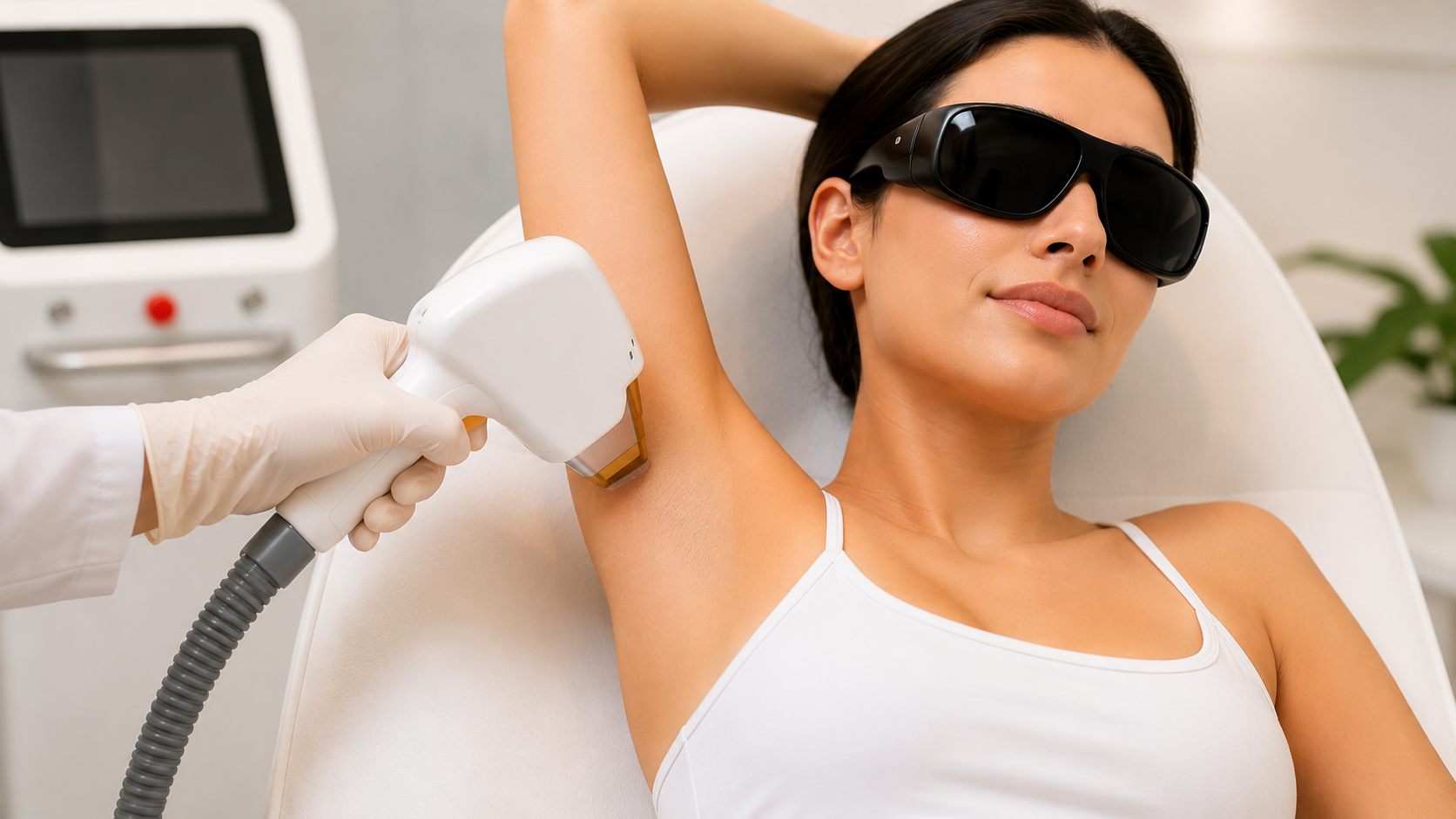
Laser hair reduction is a medical procedure that uses targeted laser energy to permanently reduce hair follicle activity via selective photothermolysis — destroying the follicle's ability to produce hair without damaging surrounding tissue.
The physics: laser energy at a specific wavelength is absorbed preferentially by melanin in the hair follicle. The absorbed energy converts to heat, which destroys the follicle's germinal matrix. The critical constraint is that the laser can only destroy follicles currently in the anagen (active growth) phase — at any point, only 20–30% of follicles on any given body area are in anagen. This is why multiple sessions are required — not because the technology is weak, but because of follicular biology. Any clinic claiming 90% reduction in 2–3 sessions is misrepresenting how the procedure works.
The Technology Problem in Hyderabad's LHR Market
At ORA, I frequently see patients who spent ₹15,000–₹40,000 on IPL sessions at beauty chains and salons and achieved minimal lasting reduction. IPL (Intense Pulsed Light) is not laser. IPL emits a broad spectrum of light wavelengths simultaneously. Laser emits a single, precise wavelength. The difference is clinically significant:
- IPL's broad spectrum means it absorbs into multiple chromophores simultaneously — melanin in the skin AND in the hair follicle. For Indian skin (Fitzpatrick IV–VI), this creates a meaningful risk of surface hyperpigmentation, burns, and post-treatment darkening.
- IPL cannot achieve the follicle-specific energy delivery that true laser systems provide.
- IPL produces inferior hair reduction outcomes in darker skin types, which is exactly the skin type of the majority of Hyderabad's patient population.
According to a 2021 review published in Lasers in Surgery and Medicine, Nd:YAG 1,064nm achieves 80–90% hair reduction after 6–8 sessions in Fitzpatrick IV–VI skin with a statistically lower adverse event rate compared to IPL and alexandrite laser systems. Hyderabad's high ambient humidity (60–80% during monsoon months) also accelerates post-treatment follicular cycling — which is one reason ORA schedules sessions at the shorter end of the 4–6 week interval window for facial LHR during summer months.
What ORA Uses — and Why
At ORA Skin & Hair Clinics in Kondapur, we use Nd:YAG 1,064nm as our primary system for the overwhelming majority of our Hyderabad patient population. At 1,064nm, the laser energy penetrates to the depth of the follicle without being absorbed by surface epidermal melanin. For darker Indian skin, this is the critical safety advantage.
For medium skin tones (Fitzpatrick III), we selectively use diode 810nm, which achieves faster reduction per session when fluence is appropriately calibrated.
We also perform a patch test before the first full-area session on every patient. This is non-negotiable at ORA. It takes 5 minutes and tells us exactly how the patient's skin responds before we treat a full leg, back, or face.
ORA's LHR Protocol — Session by Session
Session 1: Assessment + Patch Test
I assess your Fitzpatrick type, hair colour, density, and distribution. I review any medications (photosensitisers like tetracyclines increase burn risk). The patch test is performed on a small area of the treatment site. No full-area treatment at session 1.
Sessions 1–3: First Anagen Cohort
Most patients notice 20–30% reduction in hair density and re-growth rate by session 3.
Sessions 4–6: Progressive Reduction
Typical ORA patients achieve 60–75% reduction by session 6. Hair that regrows becomes finer and sparser with each session.
Sessions 7–8: Refinement
Most patients reach 80–90% reduction. Remaining hairs are often fine, lightly pigmented, or in areas with frequent hormonal influence.
Maintenance: 1–2 sessions per year for areas with hormonal hair growth: upper lip, chin, bikini, abdomen.
If You Are Comparing Laser Hair Reduction Clinics in Hyderabad
- Do you use IPL or true laser? The correct answer for Indian skin is Nd:YAG 1,064nm or a calibrated diode laser. If the answer is "IPL" or the clinic cannot name the specific system — the technology is not appropriate for darker Indian skin. Ask for the model name and wavelength.
- Do you do a patch test before the first session? Any clinic that begins a full-area LHR session without a prior patch test is not following safe practice.
- Are settings adjusted per skin type and per session? Settings should change based on your skin response between sessions. A clinic using identical energy parameters for every session is not providing individualised treatment.
- Who assesses your skin and approves the settings? In many Hyderabad clinics, a laser technician determines settings independently. At ORA, Dr. Spandana P approves the protocol for every patient.
Patients come to ORA from Kondapur, Gachibowli, Madhapur, HITEC City, and Manikonda specifically because they want dermatologist-supervised LHR with the right technology — not salon-grade IPL branded as laser.
Frequently Asked Questions
How many LHR sessions do I need?
Most ORA patients need 7–8 sessions for 80–90% reduction. Indian skin requires slightly more sessions than lighter skin types because safety-appropriate fluence levels are lower per session. Sessions are spaced 4–6 weeks apart (face) and 6–8 weeks apart (body). Hormonal areas may need 8–10 sessions plus 1–2 annual maintenance sessions.
Does LHR hurt?
At 1,064nm, the sensation is a warm pulse, often described as a rubber band snap. A cooling device is applied simultaneously with every pulse. Topical anaesthetic cream is available on request.
Can I wax or thread between sessions?
No. Waxing, threading, and epilating remove the hair shaft and follicle — the laser's target. Between sessions, shave only. Shaving is the only permitted hair removal method during the LHR course.
Is LHR permanent?
Follicles destroyed by the laser do not regrow — this is permanent. However, dormant follicles not in anagen during your session course may activate later, particularly in hormonally influenced areas. Most ORA patients are functionally hair-free after their initial course and maintain results with 1–2 annual maintenance sessions.
Book Your Free LHR Consultation at ORA, Kondapur
ORA Skin & Hair Clinics — Avalon Court, 3rd Floor, Camelot Layout, Botanical Garden Road, Kondapur, Hyderabad 500084.
Rated 4.9★ on Google · 1,000+ patients · Mon–Sun 9 AM–8 PM
Book online or WhatsApp +91 99893 61555
Book Your Free Skin / Hair Analysis
A thorough assessment worth ₹1,500 — completely free. No obligation. No pressure. Just answers. Up to 40% Off on your first visit session.
Dr. Spandana P
Dr. Spandana P is a dermatologist (M.B.B.S, M.D. Dermatology, Venereology & Leprology) at ORA Skin & Hair Clinics, Kondapur, Hyderabad, specialising in laser treatments for Indian skin.
Consult with Experts →Related Articles
Acne Treatment in Hyderabad: How Humidity, Diet and Indian Skin Affect Your Breakouts
8 min read
Dark Circles Treatment in Hyderabad: Causes, Clinical Options and What Actually Works
8 min read
Melasma vs Hyperpigmentation in Hyderabad: How to Tell the Difference and Treat Each
9 min read