By ORA's Dermatology Team | Reviewed by Dr. Spandana P — M.B.B.S, M.D. Dermatology, Venereology & Leprology | ORA Skin & Hair Clinic, Kondapur | October 2026
At ORA Skin & Hair Clinic, Kondapur — rated 4.9★ on Google — almost every hair transplant consultation includes one specific question: "Is DHI better than FUE?" The honest answer — which most clinics won't give you — is: it depends on your case, and for many patients, it doesn't matter at all. The difference in final result between a well-executed FUE and a well-executed DHI, for the same patient and the same graft count, is not visible to anyone except a specialist under magnification.
What does matter: technique selection that matches your graft count, your recipient area, your existing hair density, and your budget. Here is the comparison ORA's team uses when planning every hair transplant.
FUE vs DHI — The Core Technical Difference
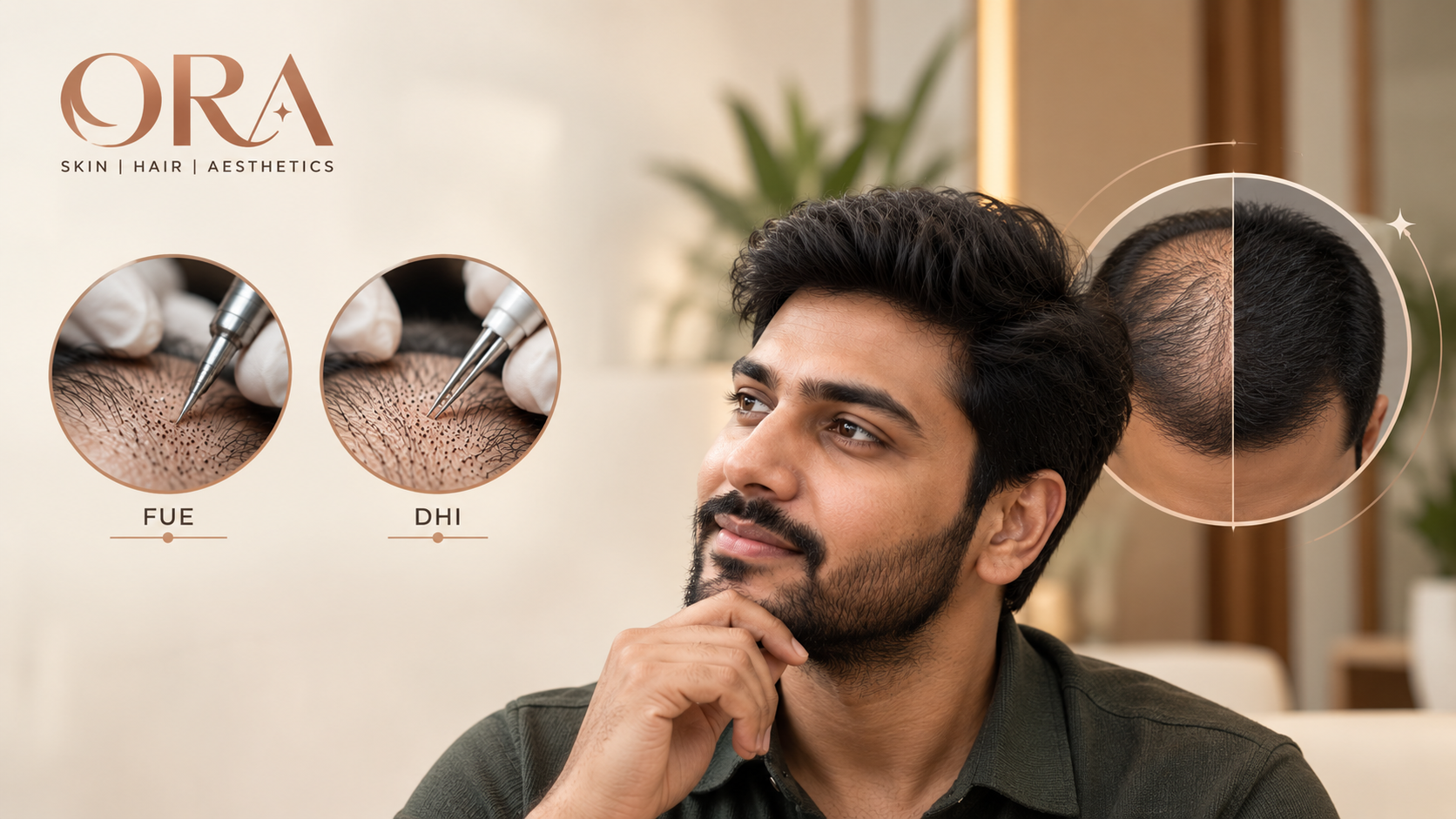
FUE (Follicular Unit Extraction): Follicles are extracted one by one from the donor zone using a micro-punch (0.8–1.0 mm). Channels are pre-made in the recipient area using a blade or needle. Extracted follicles are then implanted into the pre-made channels. The extraction and implantation are two separate steps.
DHI (Direct Hair Implantation): Follicles are extracted using the same FUE punch technique. Instead of pre-made channels, a Choi implanter pen simultaneously creates the channel and implants the follicle in a single motion. No pre-made channels are needed.
The extraction method is identical. The implantation method differs. This single difference — how the follicle enters the scalp — is what creates DHI's claimed advantages and its real limitations.
Where DHI Has a Genuine Advantage
Density in existing hair areas
DHI's Choi implanter pen allows placement between existing hairs without first making a channel — which risks transecting a live follicle. For patients adding density to an area that still has hair (early hairline recession, crown thinning with residual hair), DHI allows more precise placement without damaging what's already there. This is DHI's clearest clinical advantage.
Angle and direction control
The Choi pen allows simultaneous control of depth, angle, and direction during implantation. For frontal hairline design — where the angle of hair emergence determines naturalness — DHI gives the surgeon precision that pre-made channels followed by implantation can't fully replicate.
Reduced follicle time outside the body
Because DHI eliminates the channel-making step between extraction and implantation, follicles spend less time in holding solution. According to a 2021 study in the International Journal of Trichology, reduced out-of-body time correlates with improved graft survival — a 3–5% difference in survival rate, which compounds significantly at 3,000+ grafts.
Where FUE Is the Better Choice
Large-area coverage (2,500+ grafts)
DHI is slower per graft than FUE channel + implantation. A 3,000-graft DHI session takes 8–10 hours. A 3,000-graft FUE session takes 6–8 hours. For large Norwood Grade 4–6 cases requiring 2,500–4,000 grafts, DHI's procedure length becomes a practical problem — longer graft exposure time for later-implanted follicles, increased surgeon fatigue, and higher cost without proportional outcome benefit.
Cost
DHI costs ₹50–80 per graft at ORA vs ₹35–60 per graft for FUE. For a 2,500-graft procedure:
- FUE: ₹87,500–₹1,50,000
- DHI: ₹1,25,000–₹2,00,000
A ₹37,500–₹50,000 premium. For large-area coverage cases where DHI's density advantage is not the priority, FUE delivers the same outcome at lower cost. At ORA, we recommend DHI selectively — not as the default premium option.
Suitability for complete bald areas
DHI's advantage (avoiding damage to existing hair during channel-making) is irrelevant in completely bald areas. FUE with pre-made channels is equally precise and faster in areas with no existing hair to protect.
ORA's Technique Selection Framework
At ORA, Kondapur, we recommend technique based on three factors:
- Graft count: Under 2,000 grafts → FUE or DHI equally appropriate. 2,000–3,000 → DHI if recipient area has existing hair; FUE if fully bald area. Over 3,000 → FUE strongly preferred for session management reasons.
- Recipient area: Active hairline with some existing hair → DHI. Completely bald crown or temporal recession → FUE or DHI equally suitable.
- Budget: Where the outcome is equivalent (large bald area, 2,000+ grafts), we recommend FUE — the ₹40,000–₹70,000 saved is better invested in a second session or scar treatment if needed later.
What the Final Result Actually Looks Like — FUE vs DHI
For patients who ask whether anyone will be able to tell which technique was used — they won't. A well-executed FUE and a well-executed DHI, at the same graft count, in the same recipient area, by an experienced team, produce results that are indistinguishable to anyone who isn't examining under magnification. The technique matters for the process. It does not produce a categorically different outcome in the hands of a skilled team.
Why Patients from Across Hyderabad Choose ORA for Hair Transplant
ORA Skin & Hair Clinic, Kondapur is one of the few clinics in Hyderabad that recommends FUE or DHI based on clinical need — not based on which generates higher revenue. Patients from Gachibowli, Madhapur, HITEC City, Financial District, and Banjara Hills come to ORA because they want a written graft count estimate from an actual trichoscopy assessment, a technique recommendation with a clinical rationale, and transparent pricing. We're rated 4.9★ on Google. We offer 0% EMI on procedures above ₹75,000.
If You're Comparing Hair Transplant Clinics in Hyderabad — Ask These Questions
Before booking a hair transplant in Hyderabad, ask any clinic these four questions. At ORA, every answer is yes:
- "Do you do trichoscopy before quoting a graft count?" Any clinic that quotes you a price without examining your donor zone is guessing. At ORA, trichoscopy is the first step — always.
- "Why are you recommending FUE (or DHI) specifically for my case?" The answer should reference your graft count, recipient area, and existing hair — not "DHI is our specialty." At ORA, technique is chosen on clinical grounds.
- "Is the cost per graft or per session?" Per-session pricing hides true cost. Per-graft pricing is transparent and lets you compare accurately. At ORA, all pricing is per graft, disclosed in writing before you commit.
- "Will I receive 0% EMI options?" At ORA, 0% EMI is available on procedures above ₹75,000 — making a ₹1,20,000 FUE procedure ₹10,000/month.
Frequently Asked Questions — FUE vs DHI in Hyderabad
Is DHI better than FUE for hair transplant in Hyderabad?
DHI has specific advantages for adding density to areas with existing hair and for frontal hairline design. For large-area coverage (2,500+ grafts) in fully bald zones, FUE delivers comparable results at lower cost and shorter procedure time. At ORA, the technique is chosen based on your graft count, recipient area, and existing hair — not as a blanket recommendation.
What is the cost difference between FUE and DHI in Hyderabad?
At ORA: FUE costs ₹35–60 per graft; DHI costs ₹50–80 per graft. For a 2,000-graft procedure, this is a ₹30,000–₹40,000 difference. For a 3,000-graft procedure: ₹45,000–₹60,000 difference. Whether DHI's advantages justify the premium depends entirely on your case — which is determined at a trichoscopy consultation.
Which technique leaves less scarring — FUE or DHI?
Both FUE and DHI use the same extraction method (individual punch extraction from the donor zone), so donor-area scarring is identical — small circular dots, visible only when head is shaved to grade 0. The recipient area shows no visible scarring from either technique once healed. Donor scarring pattern is determined by the extraction method, not the implantation method.
How long is recovery after FUE vs DHI?
Recovery timelines are essentially identical for both techniques. Recipient area: redness and scabbing resolves in 7–10 days. Donor area: 5–7 days for FUE and DHI (both use punch extraction). Shock loss (transplanted hair shedding): weeks 2–6. New growth: month 3. Visible density: month 6. Final result: month 12.
Book Your Free Hair Transplant Consultation at ORA, Kondapur
ORA Skin & Hair Clinic — Avalon Court, 3rd Floor, Camelot Layout, Botanical Garden Road, Kondapur, Hyderabad 500084.
Rated 4.9★ on Google · 1,000+ patients · Mon–Sun 10 AM to 8 PM
Book online or WhatsApp +91 99893 61555
Book Your Free Skin / Hair Analysis
A thorough assessment — complimentary. No obligation. No pressure. Just answers. Up to 25% Off on your first visit session.
ORA Dermatology Team
Reviewed by Dr. Spandana P — M.B.B.S, M.D. Dermatology, Venereology & Leprology | ORA Skin & Hair Clinic, Kondapur, Hyderabad
Consult with Experts →Related Articles
FUT vs FUE vs DHI Hair Transplant in Hyderabad — Which Technique Is Right for You?
9 min read
Exosome Hair Treatment in Hyderabad: The Science, What to Expect, and Real Results
7 min read

Monsoon Hair Fall in Hyderabad — Why It Spikes in July and How to Stop It
7 min read