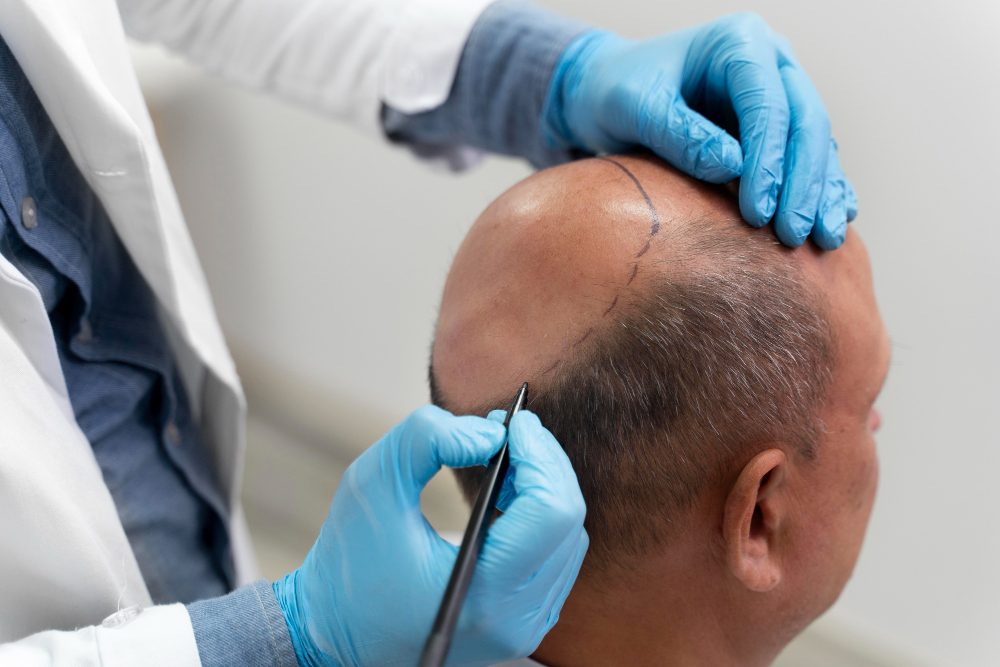
By Dr. Irfan Ahmed — Hair Transplant Surgeon | ORA Skin & Hair Clinics, Kondapur | July 2026
In every first consultation I do at ORA, patients ask me the same question: "Which technique is best — FUT, FUE, or DHI?" My answer surprises most of them. There isn't one. The best technique is the one that matches your specific donor density, your target area, your scalp laxity, and — honestly — your budget and your attitude toward recovery. A surgeon who recommends DHI to everyone is selling a procedure, not planning a surgery.
Here's how I actually think through technique selection, and what you should ask any clinic before agreeing to a procedure.
The Foundation: What a Hair Transplant Actually Does
A hair transplant relocates hair follicles from a "donor zone" — typically the back and sides of the scalp, which are genetically resistant to DHT (the hormone that causes male-pattern baldness) — to the "recipient zone" (thinning or bald areas). The transplanted follicles retain their DHT-resistance at the new location. This is why hair transplant results are permanent: you're moving hair that won't fall out. The three techniques (FUT, FUE, DHI) differ only in how follicles are extracted and implanted — not in the fundamental biology.
FUT (Follicular Unit Transplantation) — The High-Yield Option
FUT involves removing a strip of scalp from the donor area, dissecting it into individual grafts under magnification, and implanting those grafts into the recipient area. The strip removal leaves a linear scar at the back of the head — typically 1–1.5 cm wide, hidden by hair when worn at a normal length.
Who it's best for: Patients needing 3,000+ grafts in a single session; patients who don't plan to shave their head short; patients where maximising graft yield from limited donor supply is the priority.
The honest advantage: FUT extracts the highest number of viable grafts per session because strip dissection under magnification preserves follicle structure better than individual extraction. A 2020 study in the Journal of Plastic, Reconstructive & Aesthetic Surgery found FUT graft survival rates of 90–95% vs 80–90% for FUE. For large-area coverage, this difference compounds.
FUE (Follicular Unit Extraction) — The Scar-Free Option
FUE extracts individual follicular units from the donor area using a micro-punch (0.8–1.0 mm diameter), leaving tiny circular scars rather than a linear scar. These heal to small white dots, visible only when the head is shaved.
Who it's best for: Patients who want to wear their hair very short; patients needing 1,500–3,000 grafts; patients with tighter scalp laxity that makes FUT strip harvesting more difficult.
The honest limitation: FUE is slower per graft than FUT strip dissection — which matters for large-coverage cases. And the 0.8–1.0 mm punch can transect (cut) follicles during extraction if angle and depth aren't precisely calibrated. At ORA, our FUE protocol uses motorised punches with real-time depth control to minimise transection.
DHI (Direct Hair Implantation) — The Precision Option
DHI uses a Choi implanter pen to implant extracted follicles directly into the recipient area without pre-making channels. This reduces the time follicles spend outside the body and allows precise angle and depth control during implantation.
Who it's best for: Patients requiring high density in a small area (hairline refinement, eyebrow transplant); patients adding density to an area that still has some existing hair (the implanter pen avoids damaging existing follicles during channel-making).
The honest limitation: DHI is significantly slower than FUE for large coverage areas — a 2,500 graft DHI session takes considerably longer than a 2,500 graft FUE session, which increases procedure time and cost. For patients needing 2,500+ grafts over a large area, DHI's speed disadvantage often outweighs its precision benefit. I recommend DHI selectively, not universally.
How We Choose at ORA — The Actual Decision Framework
- Scalp assessment (visit 1): Trichoscopy of the donor area — follicular density count, hair calibre, miniaturisation assessment. This tells us how many viable grafts your donor zone can realistically provide.
- Norwood scale staging: We map your current and projected future hair loss pattern. A technique that works today for Norwood III may not leave adequate donor supply for a Norwood V revision in 10 years.
- Graft count estimation: Based on recipient area and donor density, we calculate required grafts. Below 1,500: FUE or DHI. 1,500–3,000: FUE preferred. Above 3,000: FUT offers highest yield. Above 4,000: FUT + staged FUE in a second session.
- Lifestyle discussion: If you want to shave your head to grade 0–2, FUE or DHI avoids the linear FUT scar. If you're comfortable with longer donor hair, FUT's higher yield often justifies the trade-off.
- Final recommendation: Written estimate of graft count, technique, sessions needed, and realistic coverage outcome before any decision is made.
Why Patients Come to ORA from Across Hyderabad for Hair Transplant
ORA Skin & Hair Clinics in Kondapur is one of the few clinics in Hyderabad that runs a full donor-area trichoscopy assessment before recommending any transplant technique — rather than defaulting to the highest-cost procedure. Patients come from Gachibowli, Madhapur, HITEC City, Jubilee Hills, and Banjara Hills because they want an honest assessment of what their donor zone can actually deliver, not a sales pitch. We're rated 4.9★ on Google. 👉 ORA hair transplant →
If You're Comparing Hair Transplant Clinics in Hyderabad
Ask every clinic these questions before signing anything:
- "How many grafts can my donor zone realistically provide?" Any clinic that doesn't check your donor density before quoting a graft count is guessing.
- "Why are you recommending this specific technique for me?" The answer should reference your graft count, recipient area, and scalp laxity — not "DHI is our specialty."
- "Who performs the extraction and implantation — the surgeon or technicians?" At ORA, the transplant surgeon is present and performing critical steps throughout the procedure.
👉 Book a free hair transplant consultation at ORA →
Frequently Asked Questions
Is the result from FUE, FUT, and DHI the same?
In terms of final hair growth, yes — if executed correctly, all three produce natural-looking permanent results. The differences are in yield (FUT is highest), recovery time (DHI and FUE faster than FUT), and scarring (FUT leaves linear scar; FUE/DHI leave micro-dot scars). The technique affects the journey, not the destination — if the surgeon calibrates technique correctly to your case.
How long is the recovery after each technique?
All three: redness and scabbing in the recipient area resolves in 7–10 days. FUT: donor area requires suture removal at day 10–14, discomfort for 2–3 weeks. FUE/DHI: donor area heals faster, back to normal activity in 5–7 days. Hair shedding ("shock loss") occurs at weeks 2–6 for all techniques — this is normal and expected. New growth begins at month 3, visible density at month 6, final result assessed at month 12.
What does a hair transplant cost in Hyderabad?
At ORA, cost is quoted per graft after the donor assessment confirms the actual graft count. A 2,000-graft FUE session and a 2,000-graft DHI session have different per-graft costs reflecting technique complexity. We provide a complete written cost breakdown before any commitment is made — no post-consultation price surprises. New patients receive 25% off the first consultation. 👉 Get your assessment →
ORA Skin & Hair Clinics | 3rd Floor, Avalon Court, Camelot Layout, Botanical Garden Road, Kondapur, Hyderabad 500084 | Mon–Sun 9 AM–8 PM | Rated 4.9★ on Google
Book Your Free Skin / Hair Analysis
A thorough assessment worth ₹1,500 — completely free. No obligation. No pressure. Just answers. Up to 25% Off on your first visit session.
Dr. Irfan Ahmed
Dr. Irfan Ahmed is a specialist in Oral & Maxillofacial Surgery and Hair Transplant at ORA Skin & Hair Clinics, Kondapur. He specialises in FUE and DHI techniques and has restored permanent, natural-looking hair for clients across Hyderabad.
Consult with Experts →Related Articles
Exosome Hair Treatment in Hyderabad: The Science, What to Expect, and Real Results
7 min read

Monsoon Hair Fall in Hyderabad — Why It Spikes in July and How to Stop It
7 min read

Dandruff Treatment in Hyderabad — What Actually Works, According to a Dermatologist
8 min read