By Dr. Spandana P — M.B.B.S, M.D. Dermatology, Venereology & Leprology | ORA Skin & Hair Clinics, Kondapur, Hyderabad | Published August 2026
At ORA Skin & Hair Clinics, Kondapur, I see more patients for pigmentation than any other concern — and most of them arrive after trying 3–4 products or even 2 other clinics first. Here is what I tell every one of them: if the pigmentation is deep, no cream will clear it. The melanin deposit is below the reach of topical agents. Q-Switch Laser is the first line of treatment we reach for — not because it is trendy, but because the evidence for it in Indian skin is the strongest we have.
Rated 4.9★ on Google · 1,000+ patients · Kondapur, Gachibowli, Madhapur, HITEC City
What Is Q-Switch Laser? The Answer That Matters for Indian Skin
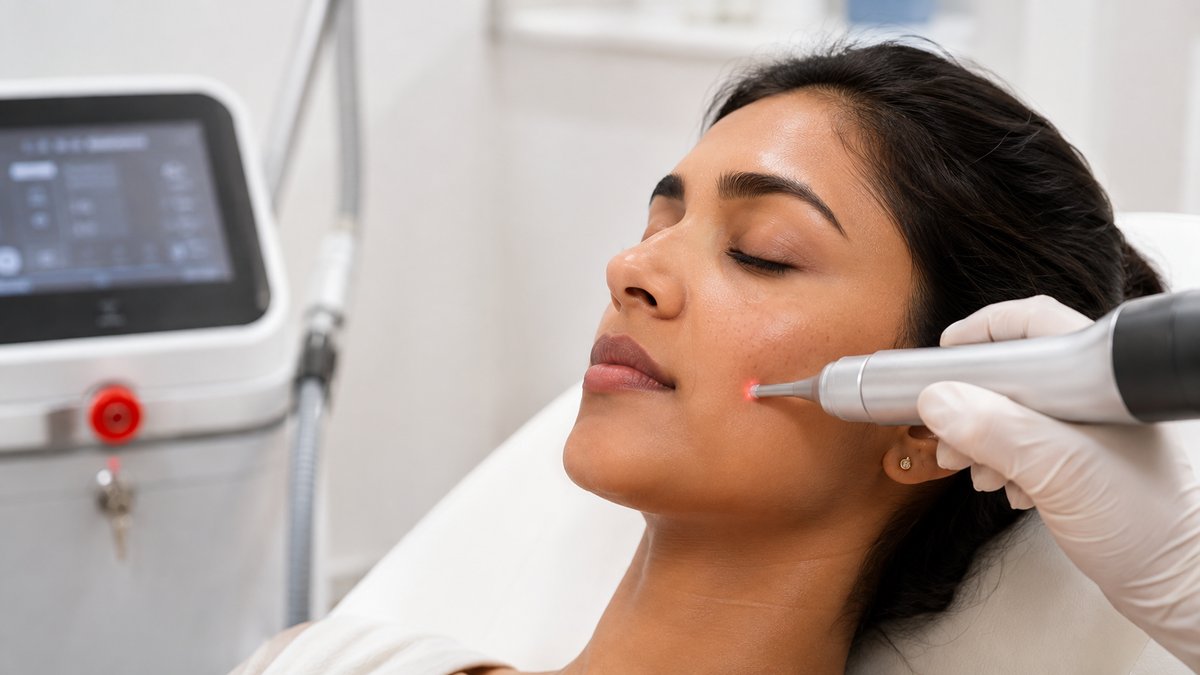
Q-Switch laser is a nanosecond-pulsed laser that delivers energy precisely enough to shatter melanin deposits without burning surrounding tissue.
This precision is what makes it different from older pigmentation treatments. The laser fires in pulses so short — measured in nanoseconds — that heat does not have time to spread laterally. The melanin absorbs the energy, fragments into smaller particles, and the body's lymphatic system clears the debris over 2–4 weeks. No surrounding skin is damaged.
At ORA, we use Q-Switch Nd:YAG at two wavelengths: 1064nm for deeper pigmentation in darker Indian skin (Fitzpatrick IV–VI), and 532nm for superficial lesions in medium skin tones (Fitzpatrick III). The wavelength selection at your first assessment is not cosmetic — it determines whether treatment works or causes rebound pigmentation.
Why Hyderabad Patients Have More Stubborn Pigmentation
I say this to patients from Gachibowli, Madhapur, and HITEC City specifically: the combination of Hyderabad's high UV index (average UV index 8–10 during summer months), ambient humidity, and pollution creates conditions where post-inflammatory hyperpigmentation (PIH) is both more common and more persistent than in cooler climates.
Higher baseline melanin content in Indian skin — Fitzpatrick III–VI — means every inflammatory trigger, whether acne, friction, or a poorly performed treatment, leaves a more pronounced dark mark. The skin produces melanin as a protective response, and in darker phototypes, that response is proportionally stronger.
According to a 2022 study in the Indian Journal of Dermatology, pigmentation affects approximately 80% of dermatology-presenting patients in South Indian urban populations aged 18–45, making it the single most common complaint — ahead of acne, hair loss, and ageing concerns. This is not a vanity issue. For many of my patients, it significantly affects their confidence at work and in social settings.
What We Treat at ORA with Q-Switch Laser
Post-inflammatory hyperpigmentation (PIH) — The dark marks left after acne, insect bites, or minor skin trauma. This is the most common presentation at ORA. According to the Journal of Cutaneous and Aesthetic Surgery (JCAS) 2022, Q-Switch Nd:YAG at 1,064nm achieves 70–90% PIH clearance in 3–5 sessions on Indian skin when combined with a tyrosinase-inhibiting topical. At ORA, we use this combined approach as our standard PIH protocol.
Melasma — Hormonal pigmentation, common in women in Hyderabad aged 25–45. Q-Switch laser is used in toning mode for melasma — low fluence, multiple passes — rather than aggressive single-pass treatment. Melasma requires a maintenance protocol. I tell every melasma patient at ORA: we are managing this condition, not curing it. The trigger — hormonal or UV — remains.
Sun spots and solar lentigines — Discrete brown spots from cumulative UV exposure. These respond fastest to Q-Switch — often 1–2 sessions. Patients from Manikonda and Miyapur who spend significant time commuting in sun exposure present with these frequently.
Freckles and café-au-lait macules — Well-defined pigmented patches. Responsive in 2–4 sessions.
Dark knuckles and neck pigmentation — More stubborn due to chronic friction and friction-induced melanin stimulation. Requires multiple sessions plus topical brightening therapy.
ORA's Q-Switch Protocol — What Happens at Every Session
1. Assessment and Fitzpatrick typing — I assess your pigmentation type, depth, and distribution before any session. I use Wood's lamp examination to determine whether melanin is epidermal, dermal, or mixed. This determines which wavelength and fluence settings we use. Most clinics skip this step and default to a single protocol for every patient.
2. Topical anaesthetic (if needed) — Applied 20–30 minutes before treatment for patients with low tolerance. Most patients find Q-Switch Nd:YAG at 1,064nm comfortable without anaesthetic — the sensation is a warm snap, not a burn.
3. Laser application — Treatment takes 20–45 minutes depending on the area size. We pass the laser systematically across the treatment area. For toning (melasma/diffuse pigmentation), we use low fluence with multiple passes. For spot treatment (discrete lesions), higher fluence with precise targeting.
4. Post-treatment care — A cooling gel is applied. I give every ORA patient a written post-care protocol — sun protection is non-negotiable. Any Q-Switch treatment without strict sun avoidance post-session is wasted.
5. Review at each session — I assess pigmentation response before proceeding. We do not do sessions on a fixed calendar if the skin has not adequately cleared between sessions.
Session intervals: 3–4 weeks. Typical session count: 3–6 for PIH and sun spots; 6–10+ for melasma with maintenance.
One Thing Most Clinics Won't Tell You
Q-Switch laser does not work on all pigmentation types — and using it incorrectly makes some types worse.
Melasma, specifically, can rebound aggressively if treated with too-high fluence settings or too-frequent sessions. I see patients at ORA who come to us after aggressive melasma treatment elsewhere with worse pigmentation than when they started. The laser triggered more melanin production as a response to heat stress.
The correct approach for melasma is low-fluence Q-Switch toning — multiple passes at low energy, not single high-energy passes. This requires a machine with precise fluence control and a clinician who understands the distinction. Many clinics use the same settings for PIH and melasma, which is clinically incorrect.
If You Are Comparing Pigmentation Clinics in Hyderabad
Patients come to ORA from Gachibowli, HITEC City, Madhapur, and Kondapur after trying clinics that gave them bleach facials or low-grade laser and saw no lasting results. Here is what to ask:
1. Do you assess pigmentation type before treatment?
PIH, melasma, and solar lentigines respond to different settings. A clinic that applies the same treatment to every dark mark has not assessed your skin. At ORA, every consultation begins with Fitzpatrick typing and Wood's lamp examination.
2. What wavelength do you use for dark Indian skin?
The correct answer for Fitzpatrick IV–VI is 1,064nm Nd:YAG. Shorter wavelengths — 532nm, 694nm ruby — carry significantly higher risk of burns and rebound hyperpigmentation in darker skin types. ORA uses wavelength-appropriate protocols for every patient.
3. Do you prescribe topical therapy alongside laser?
Laser clears existing melanin. Topical tyrosinase inhibitors (tranexamic acid, kojic acid, niacinamide) suppress new melanin production during treatment. Without both, the improvement is slower and less durable. ORA's protocols combine both — because the published evidence supports the combination over laser alone.
4. What is your protocol for melasma specifically?
Melasma requires a different approach from general PIH. Ask explicitly. If the clinic does not differentiate, you are at risk of rebound.
At ORA, Dr. Spandana P personally assesses and treats every patient. We use Q-Switch Nd:YAG with fluence calibrated per session per patient — not a fixed energy level applied to everyone.
Frequently Asked Questions
How many Q-Switch sessions do I need?
For post-inflammatory hyperpigmentation (PIH): typically 3–5 sessions spaced 3–4 weeks apart. For melasma: 6–10 sessions with ongoing quarterly maintenance, as melasma requires long-term management rather than a fixed session course. For discrete sun spots: 1–3 sessions. Your ORA dermatologist will estimate session count after examining your pigmentation type, depth, and Fitzpatrick skin type at your first visit.
Does Q-Switch laser hurt?
At 1,064nm — which is what ORA uses for most Indian skin types — the sensation is a warm snap, similar to a rubber band flick. Most patients tolerate it well without anaesthetic. The 532nm wavelength is slightly more intense. Topical anaesthetic cream is available on request for sensitive patients or large areas.
How long before I see results?
Most patients see visible lightening of treated spots 2–4 weeks after the first session, as cleared melanin fragments are removed by the lymphatic system. Maximum results from a full course appear 4–8 weeks after the last session. Sun protection during the entire treatment course is essential — without it, new melanin will replace cleared pigmentation before it can be assessed.
Is Q-Switch laser safe for Indian skin?
Yes — specifically 1,064nm Q-Switch Nd:YAG, which is the gold standard for Indian and darker skin types. The 1,064nm wavelength bypasses surface epidermal melanin and targets deeper deposits, minimising the risk of surface burns. At ORA, we use this wavelength as our primary setting for Fitzpatrick IV–VI skin. Shorter-wavelength Q-Switch lasers (ruby, alexandrite) carry higher risk in darker skin and are not used at ORA for pigmentation treatment.
Can Q-Switch permanently remove pigmentation?
Discrete lesions like sun spots and freckles — yes, results are typically permanent. PIH — results are permanent for the cleared deposits, but new PIH will form if the original trigger (acne, friction, UV) is not managed. Melasma — results are not permanent, as the underlying hormonal or UV trigger remains. ORA's maintenance protocols are designed specifically for melasma patients who need long-term management rather than a one-time treatment course.
What should I avoid before and after each session?
Before: avoid sun exposure for 2 weeks, stop retinoids and active topicals 5–7 days before, arrive without makeup. After: strict SPF 50+ sun protection every day (this is non-negotiable), avoid direct sun exposure for 2 weeks post-session, do not use active topicals (AHAs, retinoids) for 1 week unless prescribed by your ORA dermatologist.
Why Patients Choose ORA for Pigmentation Treatment in Hyderabad
At ORA Skin & Hair Clinics in Kondapur, every pigmentation case is assessed and treated by Dr. Spandana P — not delegated to an aesthetician. We differentiate between pigmentation types before selecting a protocol. We combine laser with prescription topical therapy for faster, more durable results. And we use wavelength-appropriate settings for Indian skin — not a single protocol applied identically to every patient regardless of skin type.
Patients come to ORA from Gachibowli, Madhapur, HITEC City, Manikonda, and Miyapur specifically because they want a dermatologist who understands Indian skin — not a clinic that offers laser as a cosmetic procedure without clinical assessment.
ORA Skin & Hair Clinics, Kondapur, Hyderabad
Avalon Court, 3rd Floor, Camelot Layout, Botanical Garden Road, Kondapur, Hyderabad — 500084
📞 +91 99893 61555 | WhatsApp: wa.me/919989361555
Open 7 days: 9 AM – 8 PM
Rated 4.9★ on Google · 1,000+ verified patients · Kondapur, Hyderabad