By Dr. Spandana P — M.B.B.S, M.D. Dermatology, Venereology & Leprology | ORA Skin & Hair Clinics, Kondapur, Hyderabad | September 2026
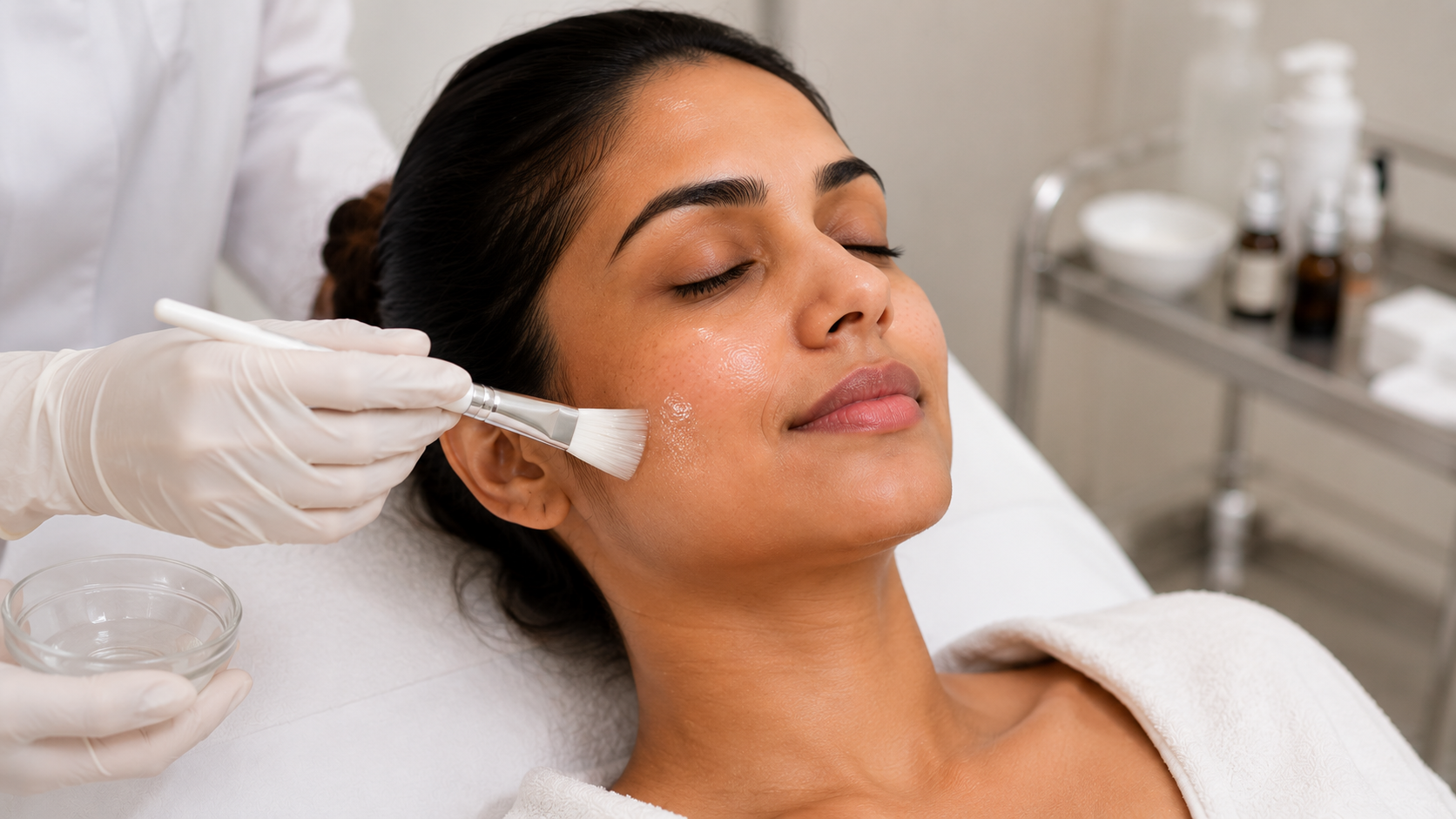
Here is something I tell patients at ORA Skin & Hair Clinics in Kondapur before their first peel: a chemical peel is not a facial. The skin response, the recovery, and the outcomes are clinically different — and treating them the same way is one of the main reasons patients come to us frustrated after spending money at beauty clinics that "did peels" with no visible results.
A well-performed chemical peel at the right concentration for your skin type produces measurable change: accelerated cell turnover, sebaceous regulation, melanin redistribution, and in the case of deeper formulations, collagen stimulation. What it does not produce is the warm-glow-that-fades-by-Wednesday that most facial treatments deliver.
What Is a Chemical Peel (Glow Peel Therapy)?
A chemical peel is the application of a keratolytic acid solution at a controlled concentration to the skin surface, causing controlled exfoliation of dead and dysfunctional epidermal cells — revealing clearer, more even-toned skin underneath and stimulating renewal of the layers below.
The word "peel" is clinically imprecise for what most dermatological peels do. At low-to-medium concentrations — which is what ORA uses for the majority of patients — the skin does not visibly peel off in sheets. Cellular turnover is accelerated microscopically. The visible effect is progressive improvement in texture, tone, and brightness over 48–72 hours post-treatment.
Why Hyderabad's Climate Makes Peels Both More Necessary and More Technically Demanding
At ORA in Kondapur, I see a specific combination in most of my peel patients: dull skin texture, uneven tone, sebum overproduction, and post-inflammatory hyperpigmentation — all presenting together. Hyderabad's average humidity of 60–80% during monsoon months and sustained heat (average 33°C in summer) creates conditions where sebum production is chronically elevated. Elevated sebum keeps dead skin cells on the surface longer, contributing to clogged pores, dull texture, and comedone formation.
According to the American Academy of Dermatology (AAD, 2023 clinical guidelines), superficial chemical peels using salicylic acid (20–30%) produce statistically significant improvement in comedonal acne, sebum regulation, and surface texture in 4–6 weekly sessions — making them one of the most evidence-based in-clinic interventions for urban South Asian skin types.
Types of Peels Used at ORA — and What Each Does
Salicylic Acid (SA) Peel — 15–30% concentration
Salicylic acid is lipophilic — it penetrates sebaceous follicles. It is the first choice for oily skin, comedonal acne, and enlarged pores. At ORA, this is our standard choice for Hyderabad patients with oily skin and active breakouts. Session interval: 2–3 weeks. Course: 4–6 sessions.
Glycolic Acid (GA) Peel — 20–50% concentration (buffered)
Glycolic acid is the smallest alpha-hydroxy acid molecule — it penetrates deeper than other AHAs. It accelerates epidermal turnover, stimulates dermal collagen production at medium concentrations, and effectively addresses surface pigmentation and fine texture. I use buffered glycolic formulations at ORA to control depth — unbuffered high-concentration glycolic peels carry a higher PIH risk in Indian skin. Session interval: 3–4 weeks. Course: 4–6 sessions.
Mandelic Acid Peel — 30–45% concentration
Mandelic acid is the largest AHA molecule — slower penetration, lower irritation risk. This makes it our choice for patients with more sensitive skin, those new to peels, or patients with active post-inflammatory hyperpigmentation who need to avoid the irritation risk that comes with SA or GA. Session interval: 2–3 weeks. Course: 4–6 sessions.
ORA's Glow Peel Protocol — What Happens at Each Session
- Pre-peel assessment — I review your Fitzpatrick skin type, current active products (retinoids and active AHAs must be stopped 5–7 days before), and any recent sun exposure. I will not perform a peel on tanned skin or skin with active inflammation.
- Skin preparation — Skin is cleansed and degreased. A degreasing step is essential — residual sebum acts as a barrier that prevents the acid from penetrating evenly.
- Peel application — The acid solution is applied systematically across the treatment area. I monitor skin response in real time — erythema (redness) indicates adequate penetration. The peel is neutralised at the appropriate endpoint. I do not leave patients unmonitored during peel application.
- Neutralisation and soothing — A neutralising solution stops the peel. A calming serum and SPF are applied before the patient leaves.
- Post-peel protocol — Patients receive a written post-care sheet: gentle cleanser only for 48 hours, no actives for 5–7 days, SPF 50+ daily, no scrubbing. Peels that are not followed with proper sun protection produce unpredictable results.
If You Are Comparing Skin Clinics in Hyderabad for Chemical Peels
- Who applies the peel, and at what concentration? In India, chemical peels above certain concentrations are prescription-only procedures. At ORA, I personally perform or directly supervise every peel. In many beauty clinics, peels are applied by aestheticians at lower concentrations than what the treatment indication requires.
- Does the clinic select acid type based on your skin concern? Salicylic acid for oily/acne-prone skin, glycolic acid for texture and collagen stimulation, mandelic acid for sensitive or PIH-prone presentations — these are not interchangeable. A clinic that offers one standard "glow peel" for every patient has not assessed your skin.
- Is the peel appropriately buffered for Indian skin? ORA uses buffered formulations calibrated for the expected depth range for each skin type. We do not use aggressive "high-downtime" peels for Indian skin unless specifically clinically indicated.
- Is there a post-peel protocol? Post-peel care is 50% of the result. At ORA, every patient receives a written post-care protocol before leaving.
Patients visit ORA from Gachibowli, Madhapur, HITEC City, Manikonda, and Miyapur specifically because they want dermatologist-led peels — not a beauty treatment that happens to use an acid.
Frequently Asked Questions
How many glow peel sessions do I need?
For mild pigmentation and texture concerns: 4–6 sessions over 2–3 months. For acne management alongside other treatments: 6–8 sessions. For event preparation: 3–4 sessions starting 6–8 weeks before the date, with the final session completed 3 weeks before the event.
Is a chemical peel safe for Indian skin?
Yes — when the correct acid, concentration, and formulation are used. The risk in Indian skin is post-inflammatory hyperpigmentation from over-penetration or inadequate post-peel sun protection. At ORA, we use buffered, calibrated formulations and always patch-test first.
Will I have visible peeling and downtime?
For the superficial and medium superficial peels we use most frequently at ORA, visible peeling is minimal to absent — you may notice light flaking on days 2–4. Most ORA patients attend sessions and return to work the same day.
Can I do a glow peel before my wedding?
Yes — peel courses are an excellent pre-wedding skin preparation. At ORA, we plan bridal skin programmes starting 8–12 weeks before the wedding date, with the final peel completed 3 weeks before the event. Do not do a first-time peel within 2 weeks of a major event.
Book Your Free Skin Consultation at ORA, Kondapur
ORA Skin & Hair Clinics — Avalon Court, 3rd Floor, Camelot Layout, Botanical Garden Road, Kondapur, Hyderabad 500084.
Rated 4.9★ on Google · 1,000+ patients · Mon–Sun 9 AM–8 PM
Book online or WhatsApp +91 99893 61555
Book Your Free Skin / Hair Analysis
A thorough assessment worth ₹1,500 — completely free. No obligation. No pressure. Just answers. Up to 40% Off on your first visit session.
Dr. Spandana P
Dr. Spandana P is a dermatologist (M.B.B.S, M.D. Dermatology, Venereology & Leprology) at ORA Skin & Hair Clinics, Kondapur, Hyderabad, specialising in skin treatments for Indian skin types.
Consult with Experts →Related Articles
Acne Treatment in Hyderabad: How Humidity, Diet and Indian Skin Affect Your Breakouts
8 min read
Dark Circles Treatment in Hyderabad: Causes, Clinical Options and What Actually Works
8 min read
Melasma vs Hyperpigmentation in Hyderabad: How to Tell the Difference and Treat Each
9 min read