FUE vs DHI Hair Transplant — Which Technique is Right for You?
FUE (Follicular Unit Extraction) and DHI (Direct Hair Implantation) are the two gold-standard hair transplant techniques. Both are minimally invasive and permanent — but they differ in the implantation method, achievable density, healing time, and which hair loss patterns they suit best. At ORA Skin Clinics, Kondapur, our surgeons perform both and recommend based on your scalp, not a preference for one technique.
Book Consultation →Or call us · 99893 61555
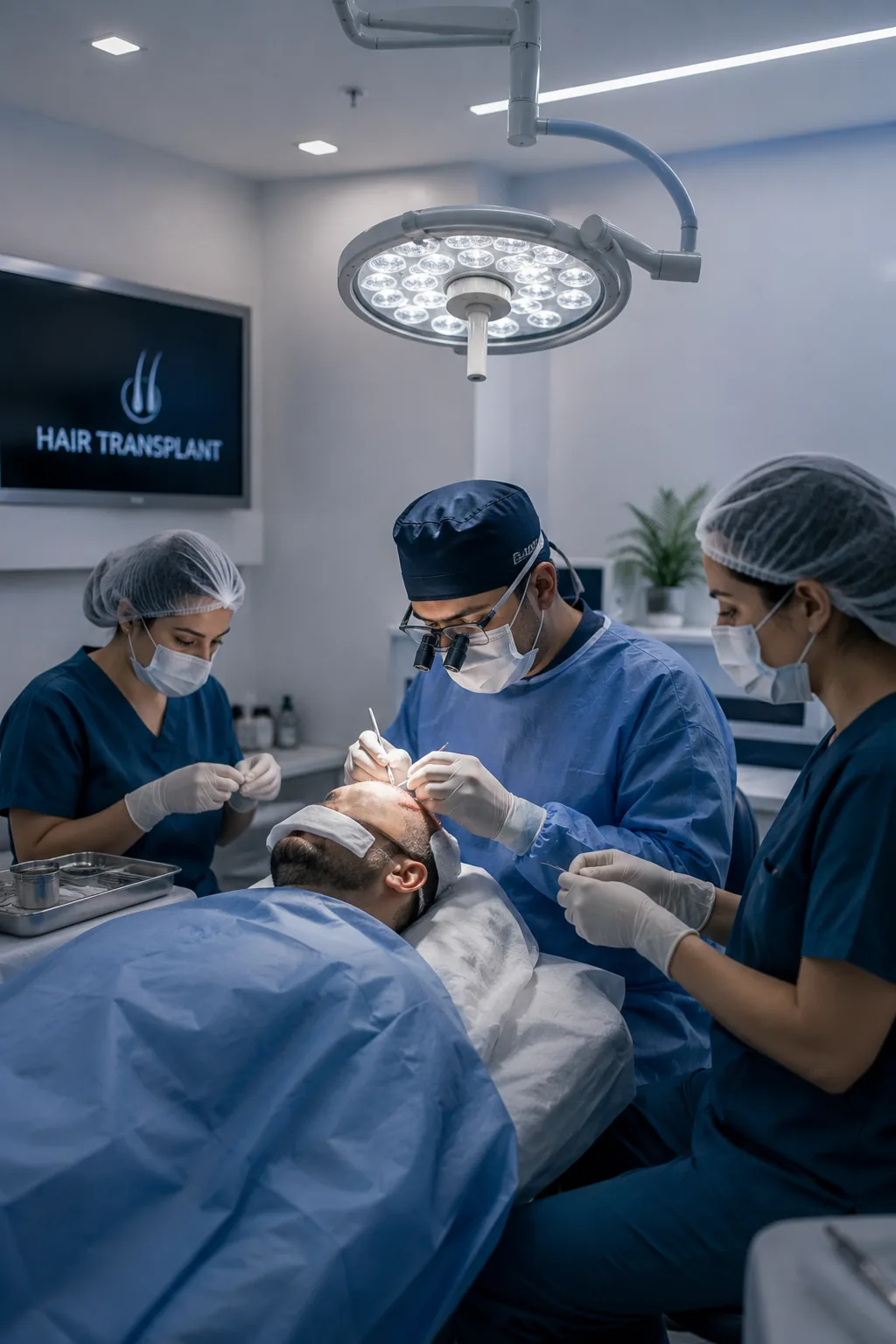
What is FUE Hair Transplant?
FUE (Follicular Unit Extraction) is the most widely performed hair transplant technique globally. Individual follicular units — naturally occurring groups of 1 to 4 hairs — are extracted from the donor zone (usually the back of the scalp) using a micro-punch tool of 0.7 to 0.9mm diameter. These grafts are stored in a preservation solution and then implanted into recipient sites (tiny incisions made in the balding area) by the surgeon. FUE leaves no linear scar — only tiny, barely visible dot scars in the donor zone that are undetectable at normal hair length. It is suitable for large graft counts (2,000 to 5,000+ grafts), full scalp coverage, and clients who prefer shorter hairstyles.
What is DHI Hair Transplant?
DHI (Direct Hair Implantation) extracts grafts using the same FUE micro-punch method, but implants them differently. Instead of creating recipient sites first and then placing grafts, DHI uses a specialised implanter pen (Choi pen) to extract, load, and implant each graft in a single step — without the graft sitting outside the body. This reduces graft handling time and exposure, potentially improving graft survival rates. DHI allows greater control over implantation angle, depth, and direction — making it particularly useful for adding density to existing hair without shaving the recipient area, and for precise hairline work.
FUE vs DHI — Side-by-Side Comparison
- Extraction method: Both use the same micro-punch extraction from the donor zone. The difference is entirely in how grafts are implanted into the recipient area.
- Implantation: FUE — surgeon creates slits first, then places grafts. DHI — Choi implanter pen creates the incision and places the graft simultaneously in one motion.
- Graft handling time: DHI reduces graft time outside the body, which may marginally improve survival rates. FUE grafts are placed in a preservation solution that maintains viability for several hours.
- Density: DHI achieves higher density in targeted zones because the Choi pen allows more precise placement in smaller areas, including among existing hair without shaving.
- Recipient area shaving: FUE requires shaving the entire recipient area. DHI can be performed without shaving the recipient area (unshaven DHI) — useful for clients who cannot conceal short hair during recovery.
- Suitable graft count: FUE handles large graft sessions well (2,000–5,000+ grafts). DHI is more time-intensive per graft, making it better suited for sessions up to 2,500–3,000 grafts, or for targeted density work.
- Healing and downtime: Both have comparable healing timelines — redness subsides in 7–10 days, transplanted hair sheds at 2–4 weeks, new growth begins at 3–4 months, full results at 12 months.
- Cost: DHI is typically higher in cost than FUE due to the specialised Choi implanter pens used per session.
- Best for: FUE — large coverage areas, advanced hair loss (Norwood 4–7), cost-sensitive clients. DHI — targeted density addition, existing hair preservation, hairline refinement, clients who cannot shave their head.
Which Technique Does ORA Recommend?
There is no universally 'better' technique — the right choice depends on your hair loss grade, the area being treated, graft count required, and your lifestyle. At ORA Skin Clinics, Kondapur, our surgeons perform both FUE and DHI and make recommendations based entirely on your trichoscopy results and treatment goals. Clients requiring large-area coverage or who are comfortable with a shaved head during recovery typically do better with FUE. Clients needing density in specific zones, hairline refinement, or who cannot conceal short hair during recovery are better candidates for DHI. Many clients at ORA receive a combination — FUE for the bulk coverage and DHI for the hairline and density zones.
Frequently Asked
Questions
Is FUE or DHI better for hair transplant?
What is the difference between FUE and DHI hair transplant?
Is DHI hair transplant more expensive than FUE?
How long does it take to see hair transplant results?
Can I choose between FUE and DHI at ORA Skin Clinics?
Book Your Free Trichoscopy Consultation
Free trichoscopy assessment at ORA Skin Clinics, Kondapur, Hyderabad. Our surgeon confirms your hair loss grade, graft count, and whether FUE, DHI, or a combination is right for you. Worth ₹2,000 — at zero cost.
Book Consultation →📍 Botanical Garden Road, Kondapur · 99893 61555