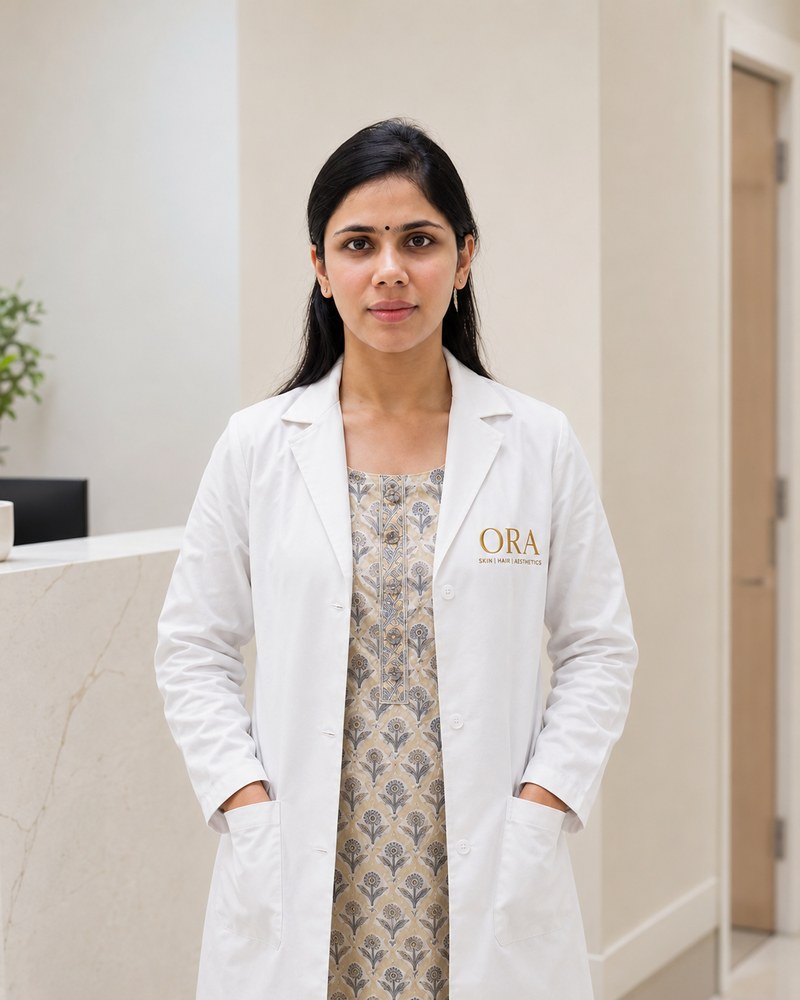
At ORA, "GFC vs PRP" is the most common question I receive from hair loss patients. Short answer: GFC is the more potent option, but both work, and the choice depends on your hair loss stage, response goal, and budget. Here's the complete picture with real numbers and the seven questions my patients always ask.
How Both Work — The Actual Mechanism
| Factor | PRP | GFC |
|---|---|---|
| Growth factor concentration | Baseline (centrifuge only) | 3–5× higher (selective isolation) |
| Inflammatory mediators | Present (red/white blood cells) | Removed |
| Post-injection discomfort | Moderate (24–48h scalp tenderness) | Mild |
| Key growth factors | PDGF, VEGF, EGF, TGF-β, FGF (mixed) | PDGF, VEGF, EGF, TGF-β, FGF (concentrated) |
| Cost in Hyderabad (2026) | ₹4,500–₹9,000/session | ₹6,000–₹12,000/session |
| Evidence base | Extensive — 15+ years of literature | Emerging — 2019–2026 comparative studies |
A 2023 study in the Journal of Cutaneous and Aesthetic Surgery compared 4-session courses of GFC vs PRP in androgenetic alopecia patients. GFC produced 68% improvement in hair density vs 52% with PRP at 6-month follow-up. Both were significantly better than no treatment.
Who Should Choose Which at ORA?
| Patient Profile | ORA's Recommendation |
|---|---|
| Moderate to significant pattern baldness (NW III–V) | GFC — higher growth factor load needed |
| Mild early thinning or preventive treatment | PRP — effective and cost-efficient for maintenance |
| Female pattern hair loss with active shedding | GFC — faster shedding stabilisation |
| Post-COVID / telogen effluvium shedding | Either — PRP for reactive shedding; GFC if loss is significant |
| Post-hair transplant support | GFC — higher growth factor concentration supports graft vascularisation |
| Budget is the primary consideration | PRP — effective, well-evidenced, and significantly cheaper |
The 7 Questions My Patients Always Ask Before Deciding
1. "Will I definitely see results?"
Both GFC and PRP work on follicles that are still active. Neither works on follicles that have been dead for years. I do trichoscopy at ORA before the first session — if I see miniaturised but living follicles, response is very likely. If I see scarring or complete absence, I will tell you directly that injectable treatment won't help.
2. "How many sessions and how often?"
Standard ORA protocol: 4 sessions, 4 weeks apart. Maintenance every 3–6 months. Results visible from session 2 onward; full benefit assessed at month 6. Do not judge results after one session.
3. "Will results last after I stop?"
GFC and PRP improve the environment for follicles — they don't cure androgenetic alopecia. If you stop and have pattern baldness, the underlying DHT sensitivity continues. Maintenance every 3–6 months is standard. Combined with finasteride or minoxidil (where appropriate), results are more sustained.
4. "Is it safe with PCOS or thyroid issues?"
GFC and PRP use your own blood — no foreign substance. I run a blood panel (thyroid, iron, vitamin D, hormones) before starting. If there's an underlying deficiency driving hair loss, we address that first. Injecting GFC into an uncorrected thyroid-deficiency patient gives suboptimal results.
5. "Can I combine GFC with other treatments?"
Yes — and I usually do. At ORA, GFC is commonly combined with topical minoxidil (5% men / 2–5% women), oral finasteride (men only, after contraindication check), and nutritional supplementation. The combination produces better results than any single modality.
6. "What's the difference between GFC and exosomes?"
Exosomes are cell-derived vesicles from donor cell lines — not from your own blood. They contain growth factors, mRNA, and microRNA at even higher concentrations than GFC. Cost is higher (₹15,000–₹30,000/session) and the evidence base is younger. I offer exosomes at ORA for patients who don't respond adequately to 4 rounds of GFC.
7. "What questions should I ask any clinic I'm comparing?"
Ask: (1) Does a dermatologist perform trichoscopy and decide treatment, or is it a technician? (2) Do you use a proper closed-system GFC preparation kit? (3) What growth factor concentration do you achieve? At ORA, I personally perform or directly supervise every session. We do trichoscopy on Day 1 for every hair loss patient.
When You're Comparing Clinics for Hair Loss in Hyderabad
ORA Skin & Hair Clinics at Botanical Garden Road, Kondapur is rated 4.9★ on Google by 500+ verified patients — the highest-rated hair loss clinic in the Kondapur area. Patients from Gachibowli, Madhapur, HITEC City, Manikonda, and Jubilee Hills visit ORA specifically for Dr. Spandana P's diagnostic-first protocol. ORA is one of the very few clinics in Hyderabad where the dermatologist personally performs trichoscopy, reads the results, and decides the treatment plan in the same consultation.
Next Steps at ORA
→ GFC vs Exosomes — Full Comparison at ORA